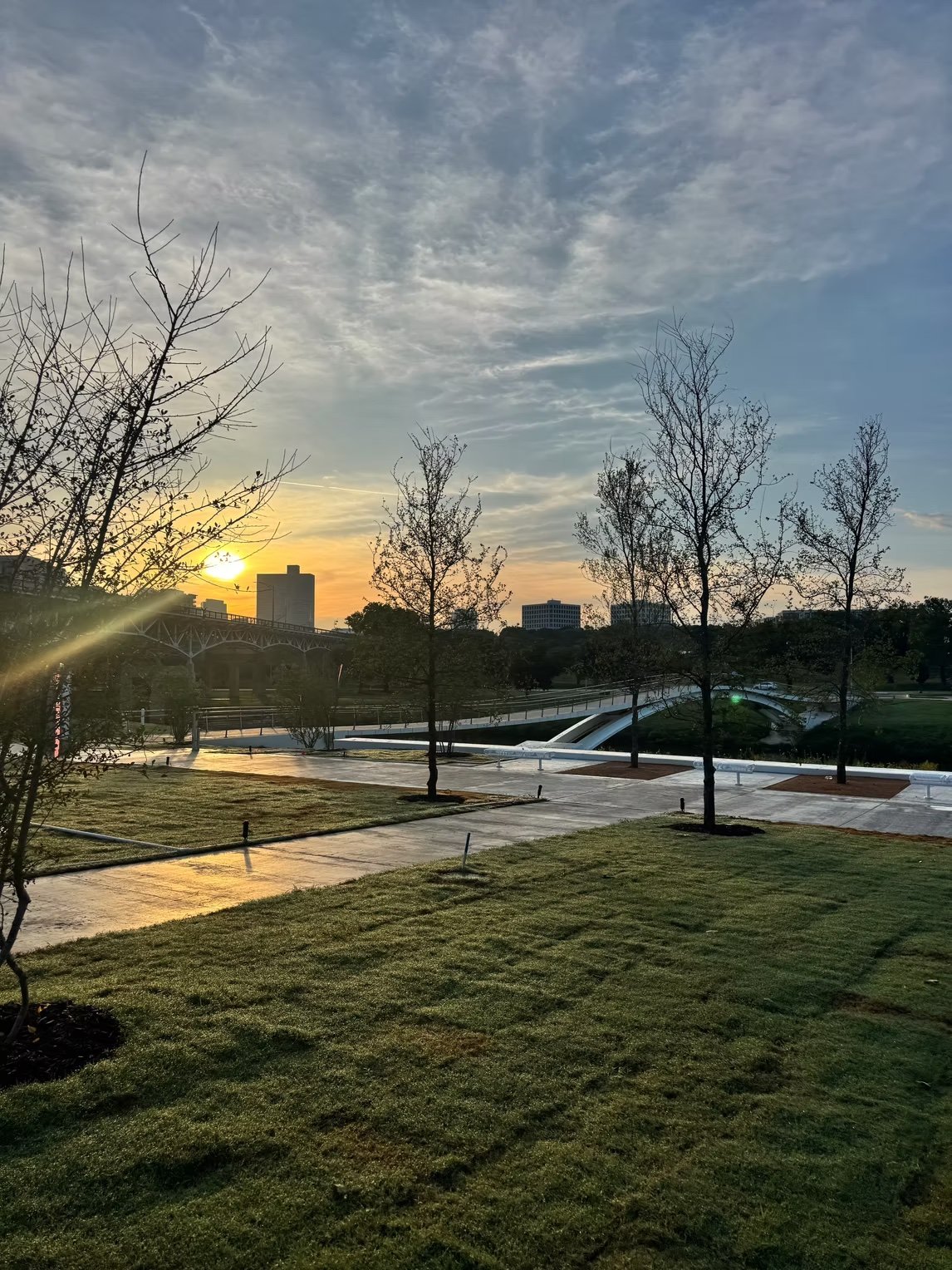
Trinity Trails Fort Worth: What’s New in 2026
Development Kemberly McLaughlin August 27, 2026
Development Kemberly McLaughlin August 27, 2026
This year’s Trinity Trails story is less about how far the system reaches and more about what Fort Worth is building around it.
The Fort Worth trail network already extends more than 100 miles, connecting parks, neighborhoods, business districts, and surrounding communities. What stands out in 2026 is not one dramatic increase in mileage. It is how the experience along those miles continues to change.
A new gathering place has opened in Trinity Park. Fort Worth’s rebuilt bike-share system is putting more electric bikes within reach. Popular trailheads have become part of established weekend routines. And as more walkers, runners, cyclists, families, and dogs share the same pathways, trail etiquette matters more than it once did.
Streams & Valleys Plaza opened in Trinity Park during the summer of 2026 near the southwest side of the Phyllis Tilley Memorial Pedestrian Bridge.
It is not another stretch of trail. It is a place to stop and enjoy the river rather than simply move alongside it.
The plaza includes:
The grove contains 63 trees, one representing each year of Tilley’s life. Her work beginning in 1969 helped Fort Worth reconsider the Trinity River as something more than a flood-control channel. The river could also become a place for recreation, beauty, and community connection.
That idea now feels familiar because residents have had decades to experience it. The new plaza is a reminder that it was once a very different way of imagining the river.
Developed through a partnership between Streams & Valleys and the City of Fort Worth, the plaza adds something increasingly valuable to the trail system: a destination that does not require an event or reservation.
You can meet a friend, rest during a ride, gather around the table, or simply sit near the river.
Fort Worth’s bike-share program also looks different today.
The previous Fort Worth Bike Sharing system ended operations in November 2024. Trinity Metro introduced its rebuilt system in 2025 with new equipment, docking stations, and a fleet designed to make cycling approachable for more people.
Trinity Metro Bikes now reports:
That makes approximately 90% of the fleet electric.
The shift matters because an electric-assist bicycle changes who may feel comfortable using the system. A recreational rider can cover more distance, handle wind or inclines more easily, and connect destinations without arriving quite as tired as a traditional ride might require.
Stations serve areas including Downtown, the Cultural District, the Trinity Trails corridor, the Stockyards, Near Southside, Near Eastside, and TCU.
The trails did not need to become longer for their practical reach to expand. The bikes make more of the existing network accessible to more riders.
They also add another reason for everyone to remain aware of how the trail is being shared.
On a busy weekend, one section of the Trinity Trails may include walkers, runners, conventional bicycles, electric bikes, scooters, strollers, children, and dogs.
That mix is part of what makes the system useful. It also requires a little cooperation.
A Fort Worth-area dog-training business drew attention in 2026 to the challenges some owners experience when dogs encounter bicycles, scooters, other dogs, and crowded trail conditions. The trainers specifically identified popular sections around Trinity Park, Clearfork, and Benbrook as places where distractions can build quickly.
That observation is not a formal trail-use study, but it will sound familiar to anyone who has walked a dog through one of the busier trailheads on a Saturday morning.
A dog that behaves beautifully at home or on a quiet neighborhood sidewalk may respond very differently when an electric bicycle approaches from behind while another dog passes from the opposite direction.
The trail did not suddenly become narrower. More people are simply using the same popular sections in more ways.
A few habits make the experience easier for everyone:
Most trail friction is not caused by one category of user. It happens when any of us forget that someone else is approaching faster, moving more slowly, or trying to manage a different set of surroundings.
The Trinity Trails are not one continuous experience. A morning at Clearfork feels very different from a wooded stretch closer to Benbrook, even though both belong to the same network.
Knowing where to begin can make the difference between loving the trail and wondering why everyone in Fort Worth arrived at the same time.
If you want… | Start near… | What you will find |
|---|---|---|
A place to gather or pause | Streams & Valleys Plaza in Trinity Park | Harvest table, wildflowers, butterfly garden, shade trees and access to the Phyllis Tilley bridge |
A social Saturday morning | The Trailhead at Clearfork | Farmers market, scheduled fitness activities, nearby coffee, dining and dog-friendly destinations |
Public art along the river | Painting the River mural locations | Murals created on flood-control structures throughout several portions of the trail system |
A quieter, more natural setting | Art Cowsen Trailhead and Pecan Valley Park | Wooded scenery, access toward southwest Fort Worth and fewer commercial gathering points |
Downtown and Cultural District access | Trinity Park and nearby bike-share stations | Connections to parks, museums, Downtown and the broader bike-share network |
A longer recreational ride | The Clear Fork and West Fork connections | Multiple trailheads and the ability to build a route around the distance you want |
The Painting the River mural project is another example of how an established trail can continue to evolve without adding pavement.
The Tarrant Regional Water District commissioned artists to transform flood-control structures along the Trinity River into public art. What had been functional concrete became a series of unexpected visual landmarks.
The murals appear across sections of the Clear Fork, Upper West Fork, and Lower West Fork.
For regular trail users, that changes the experience of a familiar route. For a first-time visitor, it creates a reason to explore parts of the system that may not have been an obvious destination.
The infrastructure was already there. The project simply invited people to see it differently.
The Trailhead at Clearfork has become one of the most social entry points to the Trinity Trails.
Depending on the day and schedule, visitors may find the farmers market, outdoor fitness programming, coffee, nearby dining, and dog-friendly activities. It is an easy place to make the trail part of a larger weekend routine rather than the entire outing.
That popularity also means it may not be the right starting point for everyone.
A buyer who imagines stepping outside for a quiet run should understand that living near the most active trailhead comes with energy, events, bicycles, dogs, and weekend traffic. Another buyer may consider that activity one of the neighborhood’s best features.
Neither response is wrong. It is a matter of understanding how the area actually lives.
For residents who prefer more space and fewer gathering points, the southwest portions of the system can feel entirely different.
The Art Cowsen Trailhead in Pecan Valley Park provides access to a wooded section near Benbrook, with natural scenery and fewer of the restaurants, markets, and organized activities that draw people to Clearfork.
It can be a better fit for someone who wants the trail primarily for distance, scenery, or a quieter walk.
Crowding can still change with the hour, weather, and season. An early morning in Trinity Park may be calmer than a holiday afternoon near Benbrook. No section carries the same mood all day.
That is why a trail map can only tell part of the story.
Shared amenities often reveal growth before a market report does.
New homes and apartments bring more residents within walking or riding distance of the river. Bike-share stations make the trail available to people who do not own bicycles. New gathering spaces encourage people to stay longer rather than simply pass through.
The result is not just more trail use. It is more varied use.
The Trinity Trails now function as recreational infrastructure, transportation, public art, park space, an event setting, and an extension of the neighborhoods along the river.
That is one reason proximity to the trails can mean different things in different parts of Fort Worth. In one neighborhood, it may mean a quiet wooded route. In another, it may mean quick access to restaurants, markets, apartments, and social activity.
“Near the Trinity Trails” is not a complete description of either lifestyle.
If trail access is important to you, look beyond the distance shown on a listing.
Ask:
A home can be close to the river without offering convenient trail access. Another may sit farther away but connect easily through a neighborhood path or nearby trailhead.
The lived experience is more important than the straight-line distance.
Fort Worth’s 100-plus-mile trail network remains one of the city’s most recognizable lifestyle amenities. In 2026, some of its most notable changes are happening within the system rather than only at its edges.
Streams & Valleys Plaza offers a new place to gather. Trinity Metro Bikes gives more residents and visitors a way to ride. Public art adds new destinations to familiar routes. Increased use asks all of us to share the space a little more thoughtfully.
Together, those changes tell a useful story about a growing city: mature infrastructure does not stop evolving once it is built. It begins adapting to the people who arrive to use it.
If you are considering a move near the Trinity River, Silver Elk Realty can help you understand more than the distance between a home and the nearest trail line. We can talk through access, activity, nearby development, commute patterns, and what that particular pocket of Fort Worth feels like on an ordinary Saturday morning.
Schedule a consultation with Silver Elk Realty when you are ready to find the part of Fort Worth that fits the way you want to live.
Stay up to date on the latest real estate trends.
Development

Education
The Questions to Research Before Making an Offer
Development
Experience a seamless real estate journey backed by a dedicated team focused on your success.