The Five TCU Saturdays That Actually Reshape Fort Worth
October 1, 2026
October 1, 2026
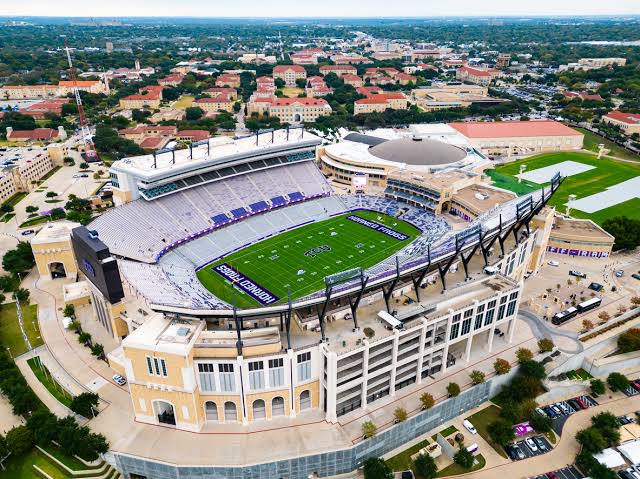
Five Saturdays this fall will fill Amon G. Carter Stadium with roughly 47,000 people and turn the streets around it into something closer to a small city's rush hour. The other Saturdays, the ones when the Horned Frogs are somewhere else, the same streets return to their usual pace. That split, five loud Saturdays against a season of otherwise ordinary ones, is the detail that actually matters if you live anywhere near University Drive, Bluebonnet Circle, or the Cultural District this fall.
TCU opened its 2026 season across the Atlantic, playing North Carolina at Aviva Stadium in Dublin on August 29. Since then the schedule has settled into a pattern that's more contained than the words "football season" usually imply. The Horned Frogs play four games away from Fort Worth this fall and have two byes, which leaves exactly five Saturdays when Amon G. Carter Stadium hosts a Big 12 crowd: BYU on October 3, West Virginia on October 24, Kansas on October 31, Kansas State on November 14, and Utah on November 21. Everything else on the calendar, including road trips to Baylor on October 17, Arizona on November 7, and the regular-season finale at Texas Tech on November 28, happens somewhere else, under someone else's stadium lights.
That distinction is easy to miss if you're new to the neighborhood and just hear "TCU plays this weekend" without checking where. It's the difference between a Saturday morning coffee run down University Drive that takes five minutes and one that takes twenty five.
The disruption isn't an all-day event. It has a shape, and the shape starts long before kickoff. Parking lots along Berry Street open about six hours ahead of game time, and University Drive parking tends to fill quickly once they do. Frog Alley, the free gathering space on the stadium's east side with team autographs, giveaways, and music, opens a few hours after the lots do, giving the pregame crowd somewhere to land before the stadium gates themselves open. The players walk through fans during the Frog Walk roughly two hours before kickoff, and the stadium gates open about ninety minutes out. For anyone who prefers to skip the car entirely, the TCU streetcar runs from downtown as an alternative to hunting for a spot.
What that means in practice: the real crunch on a home Saturday runs in the hours before kickoff, then again for an hour or so after the final whistle as everyone empties back onto the same handful of streets at once. Outside that window, even on a home Saturday, the neighborhood is doing what it always does.
One detail worth flagging for anyone planning around this fall's five dates: kickoff times for most of these games hadn't been announced as of late September. Some TCU Saturdays land at 11 a.m., which turns the whole morning into brunch and tailgate rolled into one. Others kick off in the evening, which shifts the crowd and its departure later instead. The five dates are fixed. The hour isn't yet, so the shape of the disruption on any given Saturday won't be clear until closer to game week.
The stadium sits inside a residential stretch of Fort Worth, about four miles from downtown, which is part of why the pregame crowd doesn't stay contained to campus. It spreads along a few specific streets, and it's worth knowing which ones if you'd rather avoid them or, just as easily, walk straight into them.
Along University Drive, Dutch's, named for legendary TCU coach Leo "Dutch" Meyer, and Buffalo Bros both fill up fast on gameday mornings, the kind of full where a table isn't guaranteed if you arrive after the lots do. Fuzzy's Taco Shop, a short walk from campus, handles the quicker pregame meal for people who'd rather eat standing up than wait for a seat. A few blocks over on Bluebonnet Circle, the Poop Deck functions as the neighborhood's walk-home option once the game lets out, close enough that nobody needs to drive to it. Lot 12, the rooftop bar atop the Hyatt Place TCU, is the closest spot for a drink with an actual view of the stadium, which makes it one of the first places to fill on a marquee matchup like Utah or Kansas State.
For a bigger pregame meal with more breathing room, people tend to build extra time into the day for Woodshed Smokehouse over in the Cultural District, along the Trinity River and a few minutes removed from the University Drive scrum. And across town on the North Side, Joe T. Garcia's has its own long-running gameday tradition among TCU alumni, tables set with purple and white tablecloths for the occasion. It's a fifteen minute drive from campus, but it's been a gathering spot for graduates well before Amon G. Carter Stadium's 2012 rebuild.
That geography matters for anyone weighing how close they want to be to all of this. A block off University Drive means walking distance to Frog Alley and a guaranteed wait at Dutch's. A mile or two out, in the Cultural District or toward downtown, means the option to join the crowd or skip it entirely, with restaurants like Woodshed operating at something closer to a normal Saturday pace.
The four Saturdays with games away from Fort Worth this fall—North Carolina in Dublin, Baylor, Arizona, and Texas Tech—plus the two bye weeks make up a substantial share of the season. On those weekends, the parking lots along Berry Street sit empty, Frog Alley doesn't open, and University Drive runs at its normal pace. For anyone weighing a Saturday morning in the neighborhood against a Saturday morning somewhere else, October 17 and November 7 are the two clearest windows this fall when campus stays exactly as quiet as any other stretch of the city.
That contrast is really the point. TCU football doesn't turn Fort Worth into game-day chaos for three straight months. It turns five specific Saturdays into something busier than usual, and leaves the rest of the fall calendar alone. Anyone deciding how close they want to live to that rhythm now has the actual dates to plan around, rather than a vague sense that "football season" means constant disruption from late August through Thanksgiving.
Amon G. Carter Stadium has been part of this stretch of Fort Worth since 1930, rebuilt in 2012 into the version that now seats about 47,000 people a few times a fall. Whatever block you live on near campus, those five Saturdays are the ones worth circling. The rest of the season, the neighborhood belongs to whoever's already living in it.
If you're weighing how close you want to be to University Drive on a Saturday in October, that's exactly the kind of neighborhood texture worth talking through with someone who already knows which streets fill first. Silver Elk Realty has those conversations year round, gameday or not.
Stay up to date on the latest real estate trends.
Development

Education
The Questions to Research Before Making an Offer
Development

Education
Understanding Foundation Reports and Options
Experience a seamless real estate journey backed by a dedicated team focused on your success.